The Law Society’s Conveyancing Quality Scheme (CQS) 2026 training update is available now.

Stay accredited with the trusted training supplier to over 1900 firms. Book now.

Employment Law Microcredential (Monday 7 September 2026)

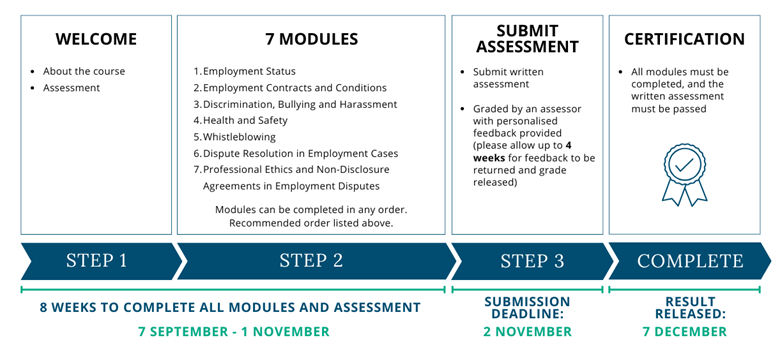
Course run: Monday 7 September 2026 – Sunday 1 November 2026

Assessment due: Monday 2 November 2026 at 5pm

Results released: Monday 7 December 2026  

Employment law establishes the legal framework that governs workplace relationships. It protects the rights of both employees and employers in contracts, specifies many workplace conditions and provides robust health and safety frameworks. 

Employment law also offers further protection when things go wrong in the workplace – it has mechanisms to safeguard against discrimination and harassment, protected disclosures and whistleblowing, dispute resolution and non-disclosure agreements.  

It is vital that employment law practitioners understand how to advise all parties in the workplace about their rights, obligations and courses of legal action open to them in different circumstances. 

Through seven modules written by industry experts, you will explore all aspects of employment law, from the types of employment statuses and contracts, through legal protections in the workplace, to dealing with disputes and ending contracts.  

Whether you are new to employment law practice or would like a black-letter law refresher, this comprehensive course is for you. Places are limited, so enrol now to avoid disappointment.  

For bulk purchase discounts on this training, please contact us 

Please note that this course has limited space and due to the nature of the programme, the course must be completed within the dates specified. It cannot be mixed and matched with other offerings. 

The course is also available in November 2025: 

You might also be interested in our microlearning Employment Rights Bill 2024 Bundle. 
What this will cover

Employment Status (by Alicia Collinson, Jodie Hill, Roshni Punja) 

This module examines the distinctions between different employment statuses, the associated legal implications and rights, and the future developments in employment status and their repercussions. 

Employment Contracts and Conditions (by Max Winthrop) 

This module looks at the creation and variation of employment contracts, including key terms, how terms may be implied, imposed or varied, and the impact of collective bargaining. 

Discrimination, Bullying and Harassment (by Alicia Collinson, Jodie Hill, Ashmina Vekaria, Roshni Punja 

This module provides insight into the Equality Act 2010, covering protected characteristics, types of discrimination, bullying and harassment, victimisation, and disability protections, along with guidance for employers on managing discrimination claims and addressing workplace concerns.   

Health and Safety (by Michael Appleby and Dr Louise Smail) 

This module explores the health and safety responsibilities of employers and employees, the core principles of risk assessment and management, and the enforcement options available to regulators.  

Whistleblowing (by Alicia Collinson, Jodie Hill, Annabelle Oliver, Roshni Punja) 

This module explores the criteria and significance of protected disclosures, the legal protections for whistleblowers, the role of regulators like the SRA, and employer guidance on managing whistleblowing matters and strategies to mitigate reputational risks. 

Dispute Resolution in Employment Cases (by Max Winthrop) 

This module covers the roles of the Advisory, Conciliation and Arbitration Service (ACAS) and Early Conciliation, the process for making claims in Employment Tribunals and civil courts, key procedural stages, drafting tribunal documentation, and challenging tribunal decisions through appeals.  

Non-Disclosure Agreements and Professional Ethics in Employment Cases (by Max Winthrop) 

This module explains the SRA Code of Conduct for employment matters, ethical issues in employment tribunal advocacy, and the use of non-disclosure agreements in employment documentation.

Learning outcomes

After completing this course, you will be able to:  

  • analyse the differences between various employment statuses, associated legal implications, and future changes  
  • describe how contracts are created, define key terms, and understand the role of grievance processes  
  • understand the protected characteristics under the Equality Act 2010 and how to guide employers on managing discrimination claims 
  • explain the health and safety responsibilities of employers and employees, the core principles of risk assessment, and the ways in which health and safety law is enforced 
  • describe protected disclosures, identify legal protections for whistleblowers, understand the role of regulators, and provide employers with guidance on managing whistleblowers  
  • examine the role of the Advisory, Conciliation and Arbitration Service (ACAS), Early Conciliation and understand the process for making claims in Employment Tribunals and civil courts 
  • explore the SRA Code of Conduct for employment matters, examine ethical issues in employment tribunal advocacy, and understand the utilisation of NDAs in employment documentation 
How you will learn

Course format 

This course is self-paced and provides best-practice guidance by incorporating practical activities, self-directed tools, and interactive scenarios designed to boost your skills and help you remain competitive. It consists of an interactive presentation for each module with knowledge checks, reflection points, and scenarios throughout the course. 

Knowledge checks feature throughout the course as an opportunity to test and apply your understanding. Please note, they do not form part of the assessment. 

Assessment
There will be an open-book assessment comprised of scenario-based, essay-style questions. Your submission should be no more than 1,200 words in total. 

You will receive the questions at the beginning of the course to allow for reflective learning. The assessment is designed to assess your knowledge and understanding of the content and learning outcomes covered within the course.  

On completion of the modules, the assessment will unlock and you will be able to upload your submission. You’re only allowed one submission attempt. 

Assessment feedback 

After you have successfully completed the course and submitted your assessment, you will receive a grade and personalised feedback. The personalised feedback will offer specific comments on your submission, highlighting strengths and areas for improvement. It will help you to understand your progress and identify areas that might need further development. 

On passing your assessment, you’ll be awarded a digital credential as evidence of your achievement that can accompany you wherever your career takes you – a quality mark you can add to your website or promote on social media to show clients that you’re competent and compliant in core legal, professional and personal skills. 

To pass the assessment, you must achieve a mark of 50%. 

Assessment dates 

The assessment deadline is Monday 19 January 2026 at 5pm. You will receive final grades and personalised feedback on Monday 2 March 2026.  

Online accessibility

Our modules conform to Web Content Accessibility Guidelines 2.1. However, some members may require an alternative version for accessibility purposes. This is available upon request via our contact us form.  

Also, if you need alternative arrangements for submitting your assessment, please get in touch. 

Meet the experts 

This microcredential has been developed by eight industry experts: 


No. of items Discount
11 – 19 20%
20 – 29 25%
30 – 39 30%
40 + 35%
£341.78 ex VAT
Type of training
CPD
Format
Microcredential
Level
Intermediate
Who is this for?
Junior lawyers
Small firms lawyers
Solicitors
Course length
8 hours
Assessment type
Scenario-based questions
SRA Competence
A2
A4
A5

The experts